If you see one mouse, how many are there?
One sighting confirms at least one mouse. The signs around it tell you more than the sighting does.
- Question
- I saw one mouse. Is it just one?
- Record
- Dated sightings, droppings, gnaw marks, catches, and, if used, sensor detections at labeled positions.
- What it cannot establish
- One sighting cannot establish how many mice are present. Neither can a motion detection.
What one sighting tells you
A sighting tells you a mouse was in that place at that time. It does not tell you whether it lives inside, came in that night, or is one of several.
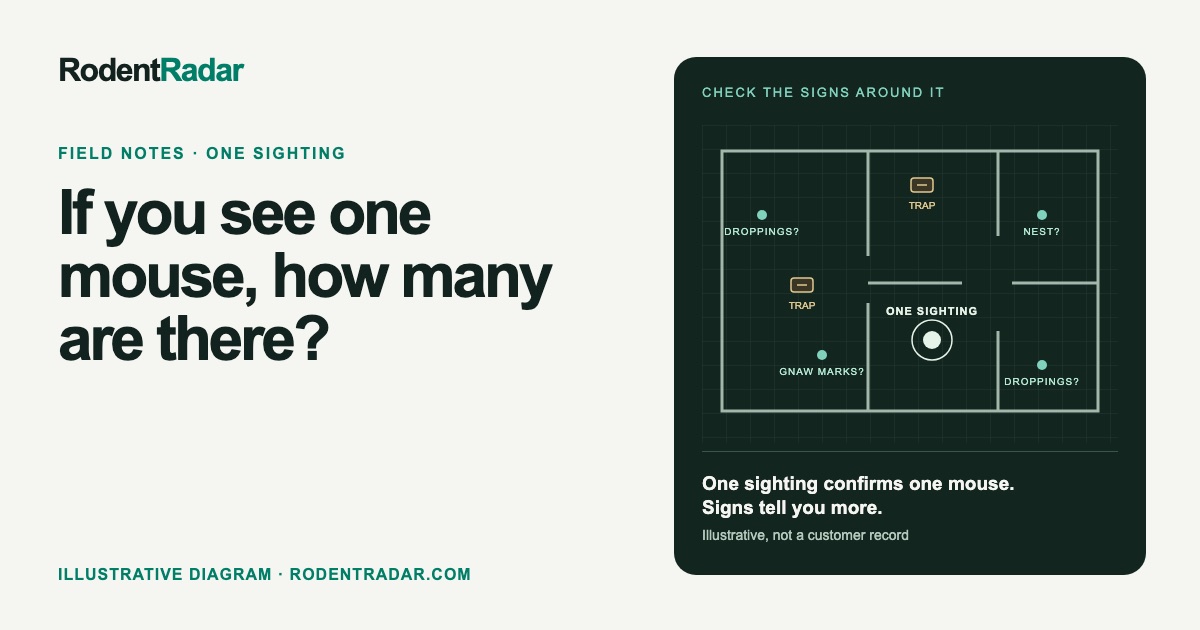
House mice are active mostly at night, according to University of California IPM guidance, so a sighting is a small sample of activity you usually do not see. Rules of thumb about how many mice hide behind each one you see are not measurements. The useful question is whether signs keep appearing.
Signs to check this week
Look in the room where you saw it and in sheltered places nearby: under sinks, behind appliances, in cabinets, closets, and storage areas.
- Droppings. Clean them up safely, then check again. CDC treats droppings that appear after cleaning as a sign of active rodents.
- Fresh gnaw marks on food packaging, wood, or wiring. Gnaw marks alone may be old.
- Nesting material such as shredded paper or fabric in a sheltered spot.
- Signs in more than one room, especially rooms far apart.
Set traps and watch what happens
Place traps where you found signs. UC IPM recommends spacing traps no more than about 10 feet apart where mice are active and using enough traps to keep the trapping period short. Check them daily, as CDC advises.
If traps keep catching or new droppings appear after cleaning, plan for more than one mouse. If a week passes with no catches and no new signs, that is a reasonable point to reassess, though not proof that the house is clear.
Find how it got in
CDC notes that a mouse can fit through a hole about 1/4 inch wide. Check around pipes and utility lines, vents, doors, and the foundation.
If you cannot find the opening, positioned motion sensors can show where motion is recorded first overnight, which narrows where to look. A detection records motion at a sensor’s position and time. It does not identify the animal or count them.
Sources and scope
This note summarizes public CDC and University of California IPM guidance on signs of activity, trapping, and sealing. It does not estimate a number of mice, because none of the public sources we reviewed gives a reliable way to do that from one sighting.
UC IPM Pest Notes: House Mouse
Night activity, signs of house mice, trap spacing, and reproduction.
CDC: Controlling Wild Rodent Infestations
Droppings found after cleaning indicate active rodents; gnaw marks alone may reflect past activity.
CDC: How to Trap Up to Remove Rodents
Check traps daily and reset them until activity stops.
CDC: How to Seal Up to Prevent Rodents
Where to look for gaps inside and outside a home.
This is general guidance written by RodentRadar, not a report from a named customer site. No review or endorsement by CDC, a university extension, or another public agency is claimed here.